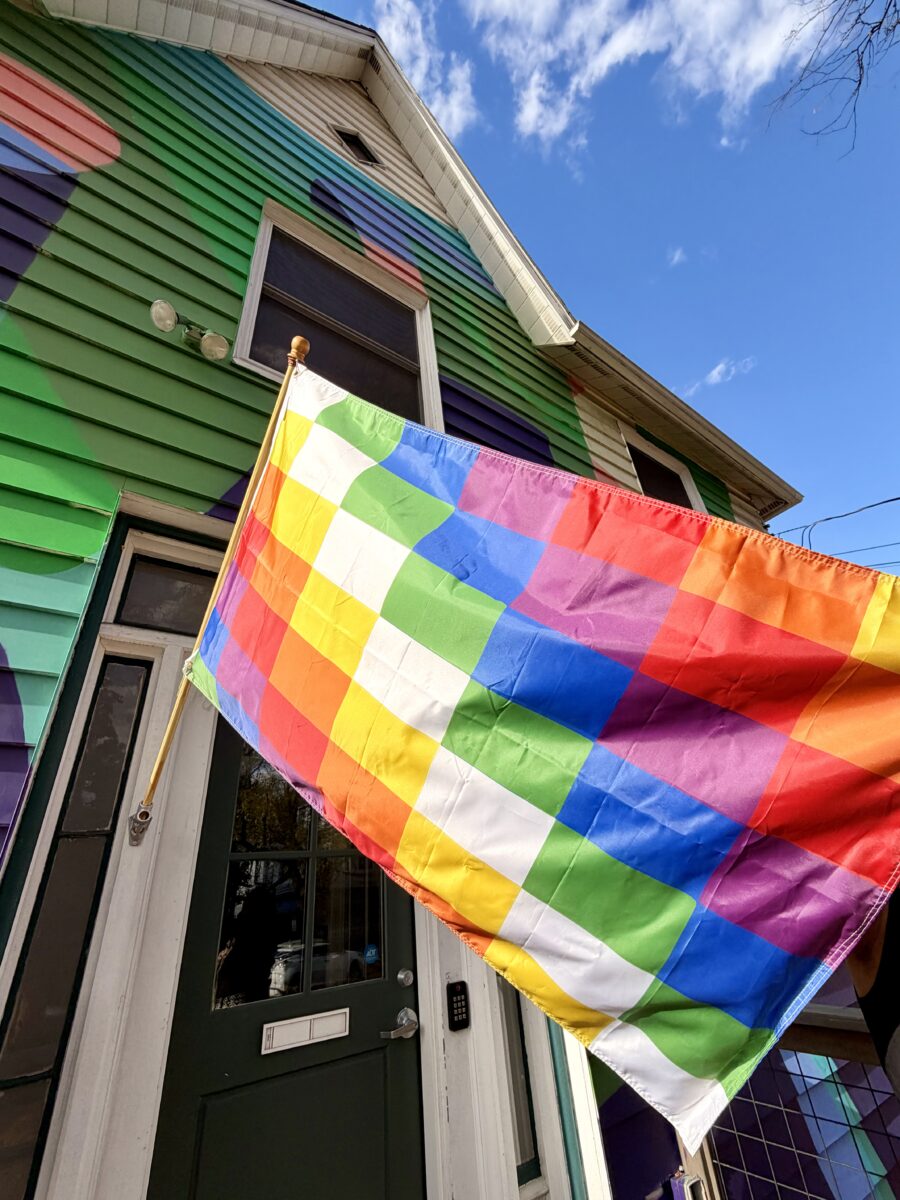

This fall, if you find yourself near 65 St. James Street, you will likely notice a distinct and colorful flag at the front door of the GWI Greenhouse. It flies in honor of Indigenous Peoples’ Day and of what this season means to ancestral communities here and across the Americas.
This is the wiphala. Its name comes from Aymara Indigenous peoples of Bolivia and is often traced to two roots: wiphay, a cry of joy and triumph, and the sound of cloth lifting and fluttering in the breeze. Together, they evoke an emblem sustained in the wind.
For generations, Andean communities of the Tawantinsuyo have carried the wiphala as a banner of resilience, a sign that their languages, ceremonies, and ways of life have endured. In 2009, Bolivia recognized the wiphala in its constitution as a national symbol alongside its tricolor flag, honoring the many Indigenous nations who call that land home. It was a triumphant moment for the communities who had kept it flying. Today it is an emblem in the wind indeed: one that Andean communities call their own, and one recognized across the Abya Yala, now called Latin America.
Its patchwork of squares holds seven colors, each carrying a teaching about our Andean cosmovision:
- Red represents the Earth (Pacha) and the intellectual and cosmic development of Andean humanity.
- Orange represents society and culture, health and medicine, community, and education.
- Yellow symbolizes energy and strength, moral principles, and human solidarity.
- White represents time and transformation, and the continuous flow of progress and science.
- Green signifies agricultural production, natural resources, and economic hope.
- Blue reflects the cosmos, the stars in our night sky, and the broader universe.
- Violet symbolizes Andean governance, self-determination, and communal harmony.
Taken together, the colors move like the steps of the Chakana, the ancestral constellation that serves as our blueprint for Sumak Kawsay, harmonious living. They remind us that earth, community, spirit, and governance are woven together, held in Ayni, sacred reciprocity; in Minka, service to community; and in Mit’a, service as community to the collective.
As this flag moves in the wind above our doorstep, I invite you to pause with me and honor the many ancestries that make up the Mahicantuck (Hudson) Valley: those whose roots reach across Abya Yala, the original peoples who remain here on this land, and those living today who were displaced from the place they once stewarded.
Let us also honor their work. Across traditions, the spiritual walk goes by many names: the Saq’be, the white road; Sumak Kawsay, the good life; the Red Road; the good way; and countless others. Each names the moment when blood memory calls us into service, to the Pachamama of this region and to one another. In a time when community, life-affirming change, and nature need to lead the way, may we answer that call together.
—
Mitzy Clementina Bautista, Anka Uma Kuntur Sonqo (Eagle Mind, Condor Heart) (she/her), is a U.S.-born Quechua and Aymara resident of the Mahicantuck Valley, an Indigenous advocate and organizational management consultant committed to building regenerative, just, and life-affirming communities. Mitzy joined the Good Work Institute’s Deep Democracy team in spring 2026. You can read more about her on our People page.